Before you start
How to read a trading pair without mixing up the units
Read the slash as “priced in,” then attach an asset unit to every number on the order form.
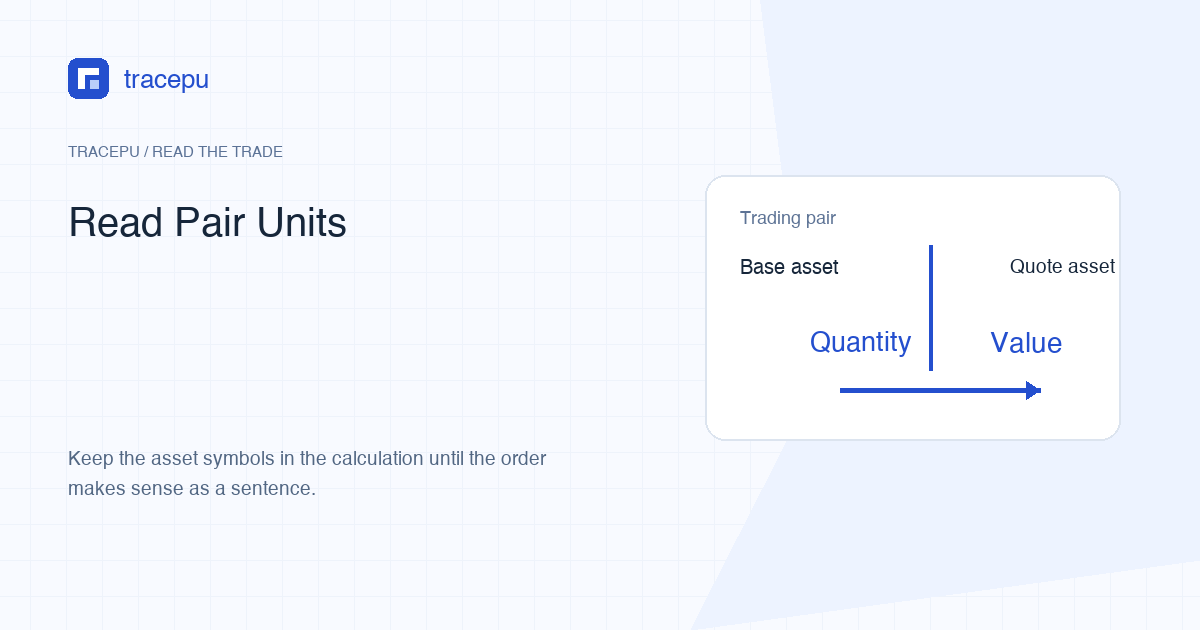
The slash in a trading pair can be read as “priced in.” If the screen says NOVA/USDT = 3.20, read it as “one NOVA is priced at 3.20 USDT.” That single sentence identifies the asset being traded, the unit of the price, and the direction of a buy.
Numbers become easy to confuse when their asset labels are missing. A box contains “7,” another contains “3.20,” and the preview shows “22.40.” Those numbers are not interchangeable. They mean 7 NOVA, 3.20 USDT per NOVA, and 22.40 USDT.
Base is on the left; quote is on the right
Binance's Spot glossary defines a symbol as a trading pair made of a base asset and a quote asset. The base asset is first. It is the asset represented by order quantity. The quote asset is second. It is the asset used to state price.
NOVA/USDT
- NOVA: base asset, the item being bought or sold.
- USDT: quote asset, the unit used to price NOVA.
- 3.20 USDT/NOVA: the pair price.
The words buy and sell refer to the base asset. Buy NOVA/USDT and you receive NOVA while giving up USDT. Sell NOVA/USDT and you give up NOVA while receiving USDT. This is easier to remember than trying to infer direction from the color of a button.
The role belongs to the pair, not permanently to the asset. In NOVA/USDT, NOVA is base. In ORBIT/NOVA, NOVA is quote. It moved from the left side of the first pair to the right side of the second, so its job changed from traded quantity to price unit.
That role change also changes the meaning of “buy.” Buying ORBIT/NOVA means receiving ORBIT and paying NOVA. It does not mean buying NOVA. If you want to increase NOVA in that pair, you would be selling the base asset ORBIT for the quote asset NOVA.
Price is a rate, not an amount
A pair price is a rate with two units. Writing only “3.20” hides what the number means. Writing 3.20 USDT per NOVA shows that every one NOVA costs 3.20 USDT in the example.
This matters when a chart or ticker displays several values. A last price reports the latest completed trade. A bid and ask refer to current buy-side and sell-side orders. All can use the same quote-per-base unit while representing different parts of the market.
If NOVA/USDT changes from 3.20 to 3.50, NOVA became more expensive in USDT terms. It does not tell you why, guarantee the next execution at 3.50, or say anything by itself about NOVA's price in a different quote asset.
Quantity and spending amount are different
In the basic Spot vocabulary, quantity is the amount of base asset. A limit order for 7 NOVA therefore has quantity 7 NOVA. The quote amount is calculated from price multiplied by quantity.
7 NOVA × 3.20 USDT/NOVA = 22.40 USDT.
The unit NOVA cancels in the multiplication, leaving USDT. The result is the order's notional value before fees.
A market-buy form may instead ask how much quote asset you want to spend. Binance calls the API-side concept quoteOrderQty: an amount of quote asset to spend or receive in a reverse market order. If you enter 25 in that field, it can mean 25 USDT, not 25 NOVA.
The same screen can therefore contain two valid ways to describe an intended buy: “buy 7 NOVA” or “spend 25 USDT on NOVA.” They are not guaranteed to produce an exact conversion into each other because a market order can match at more than one price and fees affect the final balances.
For a sell, a quote-amount field can be even easier to misread. The base quantity is what you give up, while the quote amount is the value received before fees. Stop if the preview sentence does not name which asset leaves and which one arrives.
Label a buy and a sell before submitting
Use a three-line translation for a buy:
- I am buying the base asset: NOVA.
- I am paying the quote asset: USDT.
- The price is measured in USDT per NOVA.
For a sell, reverse the flow but keep the price unit:
- I am selling the base asset: NOVA.
- I expect to receive the quote asset: USDT.
- The price is still measured in USDT per NOVA.
Suppose you sell 4 NOVA at a limit of 3.40 USDT per NOVA. The gross notional is 13.60 USDT. A sell limit can execute at 3.40 or higher under the basic definition, but it may remain open if compatible buyers do not reach that level.
Do not confuse notional with the net result
Notional is price multiplied by quantity. It is useful for checking the scale of a limit order and whether it meets current trading filters. It is not automatically the exact amount that leaves or enters the balance.
- Execution: a market order can trade at multiple prices, and a partially filled order can have both an executed notional and an unfilled base quantity.
- Valid values: symbol rules can constrain price increments, quantity steps, notional, and other limits. Current pair and account rules control, not a number copied from a tutorial.
- Units: a 0.1 NOVA quantity step still produces base-asset quantities, while a 0.01 USDT price step still produces prices measured in USDT per NOVA. Precision changes which numbers are valid, not what they mean.
The net result belongs to the execution, fee, and balance records rather than the preview alone.
Keep the percentage attached to its unit. A move from 3.20 to 3.52 is a 10% rise in the USDT price of NOVA: (3.52 − 3.20) ÷ 3.20 = 10%. It does not mean your USDT balance rose 10%. Your asset quantity, fees, and whether you actually traded are separate facts.
Use the unit check on any pair
Before submitting, say the pair, side, price, quantity, and total as one sentence. “Sell 4 NOVA at no less than 3.40 USDT per NOVA, for a gross notional of 13.60 USDT before fees.” If the sentence and the form disagree, fix the form or abandon the order.
- Identify the left symbol as base.
- Identify the right symbol as quote.
- Write price as quote per one base.
- Write quantity with its asset label.
- Multiply price by base quantity to check notional.
- Check whether the amount field expects base quantity or quote spending amount.
Once every number has a unit, the order stops being a row of unrelated boxes. It becomes a specific exchange of one asset for another that you can check before submission and reconcile after execution.