Before you start
Limit order or market order: what changes before you click
Choose the uncertainty you can accept: waiting for a price or accepting the prices available now.
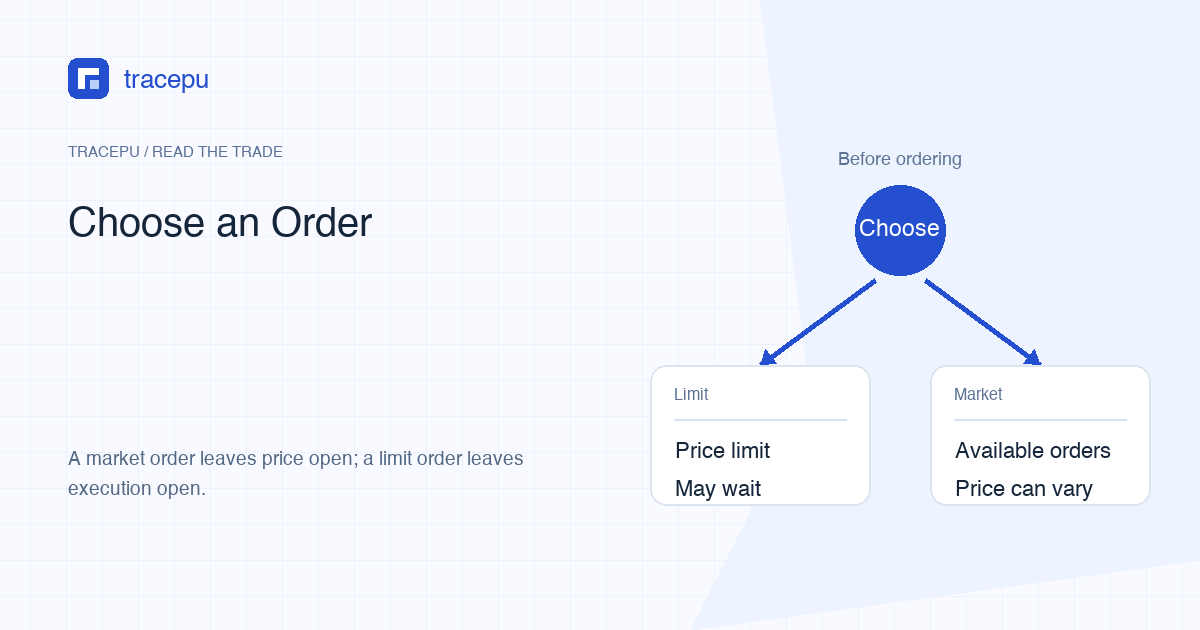
Choose a limit order when the price matters more than the timing, and a market order when trading now matters more than the exact average price. A limit order controls the worst price you will accept and leaves open the question of when, or whether, it fills. A market order asks to trade now against available liquidity and leaves the final average price open.
That trade-off is more useful than the usual labels “beginner” and “advanced.” Both order types can be used well or badly. The right first question is: which uncertainty does your plan allow?
Both orders meet the same order book
The order book is a list of open bids and asks for a trading pair. Bids are buy-side interest. Asks are sell-side interest. A trade occurs when compatible instructions meet.
Suppose the sell side of a fictional MINT/USDT book shows:
| Price | MINT available | Quote value |
|---|---|---|
| 10.00 USDT/MINT | 2 MINT | 20.00 USDT |
| 10.10 USDT/MINT | 3 MINT | 30.30 USDT |
| 10.30 USDT/MINT | 6 MINT | 61.80 USDT |
The book is only a snapshot. Orders can arrive, cancel, or fill before yours reaches the matching engine. Still, it shows why quantity matters: there may be enough at the best ask for a small order and not enough for a larger one.
A market order accepts available prices
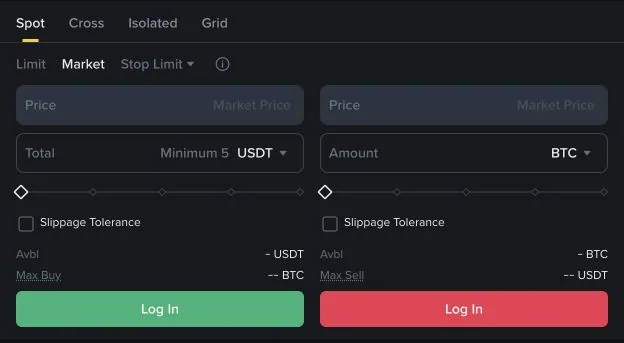
Binance's Spot glossary describes a market order as buying or selling at the best available prices and liquidity until it fills or the order book's liquidity is exhausted. There is no fixed execution price in the instruction.
If a market buy requests 5 MINT in the example snapshot, it could take 2 MINT at 10.00 and 3 MINT at 10.10. The total quote value would be 50.30 USDT, and the weighted average would be 10.06 USDT per MINT before fees.
The latest displayed trade could still say 10.00. That number is a completed past trade, not a promise that five new units are available at 10.00. The difference between the reference price you saw and the average execution is commonly called slippage.
Market orders are useful when prompt execution matters more than a precise boundary and the order is modest relative to available liquidity. They become harder to predict in a thin or fast-moving book. “Market” should never be translated into “any price is safe.”
A limit order sets a boundary
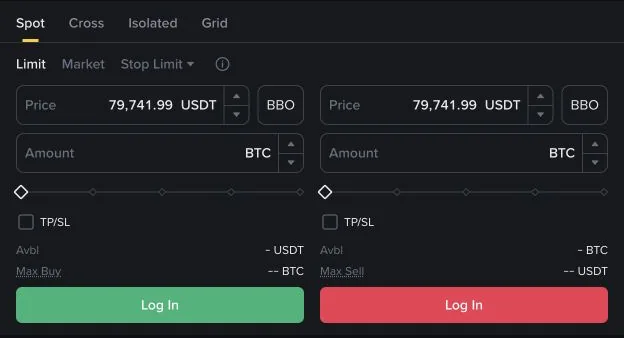
A limit order says the execution price must be no worse than the price you set. For a buy, that means the limit or lower. For a sell, it means the limit or higher.
A buy limit for 5 MINT at 10.00 could take the 2 MINT available at 10.00 in the snapshot, then leave 3 MINT unfilled. It cannot simply move to 10.10 because that is worse than the buyer's maximum. The order may remain partially filled while waiting for new sellers at 10.00 or below.
If the same buy limit were 10.15, it could immediately match the 10.00 and 10.10 asks, subject to the real book when received. A limit order therefore can execute immediately. The label does not mean it must wait.
At a price away from compatible liquidity, the order can remain open indefinitely under a Good Til Canceled instruction until it fills or is canceled, subject to exchange rules. Price reaching the limit on a chart also does not prove your entire order filled: there may have been limited opposing quantity and orders ahead of yours.
Maker and taker are execution roles
A common shortcut says “limit equals maker” and “market equals taker.” The second half is often directionally useful because a market order consumes existing liquidity. The first half is unreliable. A marketable limit order can immediately consume existing orders and be a taker.
Maker and taker describe how an execution interacted with the book. A resting order that adds liquidity can be maker when it later matches. An immediately matching order removes liquidity and can be taker. Fee schedules may distinguish these roles, but current account tier, promotions, fee asset, and product rules still matter.
Choose the order type for execution behavior first. Check current fee information separately. Trying to force a maker role without understanding the price and fill risk can leave an order sitting where your trading plan did not intend.
Partial fills belong to both decisions
A limit order commonly fills in pieces because compatible liquidity arrives in pieces. The completed quantity is real; the remainder is still governed by the order unless it expires or you cancel it.
A market order can also end with less than requested if accessible liquidity is exhausted or other exchange constraints intervene. Market does not mean infinite liquidity. Always read the executed quantity rather than assuming the original quantity completed.
Time-in-force instructions change what happens to unfilled quantity. GTC can keep it active. IOC attempts to fill as much as possible immediately and expires the rest. FOK expires without a fill unless the full amount can execute immediately. Use only the options shown and supported for the specific order, and learn their effect before selecting them.
Choose from your written plan
A limit order fits a plan that contains a hard price boundary: “Buy up to 5 MINT, but never above 10.05 USDT per MINT.” You accept waiting, non-fill, or partial fill in exchange for that boundary.
A market order fits a plan that says prompt execution matters and the final price can vary within a risk you have assessed: “Sell a small amount now, after checking the available bids and estimated result.” You accept uncertainty in the average price.
- Read the pair and units.
- Check the free balance in the correct Spot asset.
- Look at book depth for the intended quantity.
- State the price boundary or the accepted price uncertainty.
- Check current quantity, price-increment, and notional rules.
- Plan where you will verify status, executed quantity, fees, and balances.
Judge the result by records
After submitting either type, find the order record. A confirmation means little without a status. Check original quantity, executed quantity, remaining quantity, average execution price if shown, fees, and final balance changes.
If a limit order stays open, do not convert it to a market order reflexively. First ask whether the original price boundary still matters and whether any portion already filled. If you cancel and replace, confirm the old order's final executed quantity before sizing the new one.
If a market order fills at an unexpected average, check each available fill price, quantity, and timestamp. The order may have crossed several levels, the book may have moved before execution, or both. If you took a screenshot of the book before submitting, set it beside the fill list and mark any fills priced beyond what the screenshot showed. Next time, write down the worst average price you would accept for a market order; if the visible book is too thin to meet it, place a limit order at that price instead.